What's happening to LTT (Linus Tech Tips) in 2026
LTT's 2026 struggles explained: falling views, key departures and what's next for Linus Sebastian's tech YouTube empire and Linus Media Group. We are huge fans of LTT and would really like the channel to be back on its feet.
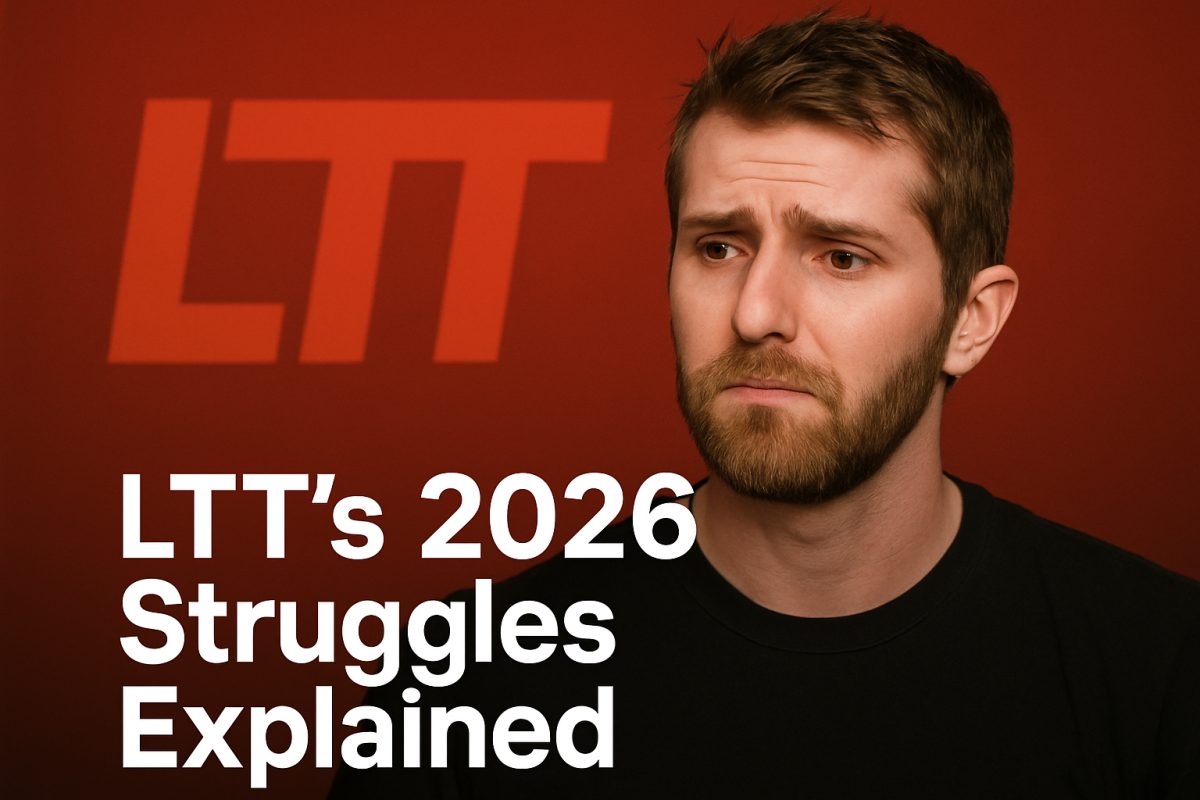
In August 2025, the man behind one of YouTube's largest technology channels told his audience that something had gone badly wrong with its viewing figures. A year later, the departures, the numbers and his own stated plans all point in the same direction.
Linus Tech Tips has around 16.9 million subscribers and more than 9.6 billion lifetime views. It is one of the three largest technology channels on the platform and the flagship of Linus Media Group, a Vancouver company that employed roughly 120 people as of January 2026. It is also, by its founder's own account, in the middle of the hardest period it has faced.
The night the numbers stopped working
On the WAN Show of 29 August 2025, Linus Sebastian told viewers the channel had been on the "struggle bus" and described what had happened as a very dramatic shift. The figures he gave were specific. Uploads that had regularly cleared 1.2 to 2 million views a month earlier were pulling around 350,000 in the first day and a half. The live show itself was drawing about three-quarters of its usual audience.
He was careful not to blame the recommendation system outright, saying he had contacted YouTube directly rather than join the creators who reflexively shout about the algorithm. He also raised the more uncomfortable possibility: that the packaging or the content simply was not delighting people any more.
Two structural admissions came in the same broadcast. The first was that the upload schedule had already been reduced. The second was that he was considering shutting down YouTube memberships entirely, because members-only posts were cluttering the channel and might be costing public videos valuable impressions.
His co-host Luke Lafreniere made the sharpest analytical point of the night. If the cause were reputational damage from earlier controversies, he argued, it would have applied four weeks earlier too, when performance was still strong. Something else was going on.
Why the recent figures need reading carefully
This matters for anyone judging the channel's recovery. Videos published in the past few weeks have accumulated their views under the more generous rule; videos from two or three years ago banked theirs under the stricter one. Sebastian has already begun distinguishing between the two in his own commentary, which tells you how seriously the distinction is being taken internally.
What the back catalogue shows
We analysed a scrape (from last 3 years only) of the channel's full public video listing. It contains 1,587 entries, of which 968 carry a view count; the remaining 619 are members-only posts with no public figure, so more than a third of what the channel publishes cannot be measured from outside. Across the 968 measurable videos sit roughly 2.2 billion views.
The per-video figures are the more revealing measure, because they are not affected by how many videos each period contains. The median is the number to watch: unlike the average, it is not dragged upwards by the occasional runaway hit.
- Median
- Mean
Some of that fall is simply age. But not all of it: videos published eight to eleven months ago, which have had ample time to settle, still average well below the cohort immediately preceding them.
The shape of the distribution has changed more than the average has. Among videos around three years old, 25 cleared five million views and only five failed to reach one million. Among those published in the past twelve months, three cleared five million and seventy fell short of a million. The ceiling has come down and the floor has dropped out at the same time: roughly three in ten uploads now miss a mark the channel used to clear as a matter of routine.
Two caveats apply throughout. The published counts are rounded to two significant figures, so the totals carry a small margin of error, and the comparison spans the August 2026 counting change described earlier — which, if anything, flatters the most recent cohort rather than the older ones.
The contraction started earlier than most people noticed
The view slump was not the first sign. In mid-November 2024, three Linus Media Group channels went dark in the same week. Mac Address, Techquickie and GameLinked all announced via YouTube community posts that they were taking a break. Mac Address had run for three years and 122 videos, fronted throughout by Jonathan Horst — unusual for the company, which normally promotes hosts from its own writing team.
Two days later, on 17 November 2024, Horst indicated on X that he had been laid off. He described it, without rancour, as the second layoff of his career, and said working on the channel had been a privilege. He returned to YouTube independently on 12 February 2026 with a channel called Thinking Different.
November 2024
Three channels go on indefinite hiatus in a single week. Jonathan Horst indicates he was laid off.
June 2025
Alex Clark is dismissed after management determines his new automotive channel breached a non-compete clause.
August 2025
Jake Tivy resigns after almost ten years. Three weeks later, Sebastian tells viewers the channel is struggling.
February 2026
Tivy's resignation video goes viral. Sebastian answers on X with a series of jokes.
Three departures, three different stories
Alex Clark was dismissed on 17 June 2025. By his own account, human resources told him his automotive channel, Zip Tie Tuning, breached the non-compete clause in his contract, and offered him three options: take the channel down, hand it to the company and run it as an employee, or be dismissed with a severance package and keep it. He chose the third and has said publicly it was not a hard decision. He also described feeling, before he left, that he was rehashing old videos for new sponsors.
Clark's account included a detail that says a good deal about how the channel's most expensive output worked. The elaborate builds — the camper van, the fire truck, the pyramid PC — each needed a sponsor to fund them, with the business team selling the concept after the idea emerged from a writers' meeting. That is a format with a structural dependency on advertiser appetite.
Emily Young left for independent work without setting out a single reason. Her account is the quieter one and, in some ways, the more revealing. She described going solo without support staff, without test equipment — she cannot review a new processor or graphics card at all — and with uncertain income. Her stated ambition for the new channel was to prove that success is possible without clickbait, hot takes or spectacle.
Pay became the flashpoint
Jake Tivy's departure is the one that broke through. He resigned on 6 August 2025 after nearly ten years, having joined at fifteen through a Craigslist advertisement and risen to supervise the Linus Tech Tips writing team. He joined when the channel had just over two million subscribers and the company had around ten staff; he left when it had more than a hundred.
In a video published on 28 January 2026, he said his total compensation had remained effectively unchanged for more than three years while affordability in Vancouver deteriorated. He researched the revenue his videos generated, took outside offers, and named a figure. The company neither accepted it nor countered. He resigned without severance and supported himself doing car repair work.
You kind of start thinking while you're working on your boss's third house, if you're ever going to be able to buy a house.
He was scrupulous about it. He noted the company was within its rights, credited the sacrifices its founders had made, and said he was far from the only person who felt undervalued. His other complaint was about the work itself: a growing pressure to identify what could be delegated to someone else, which on projects chosen because he wanted to learn something left him feeling relief rather than accomplishment when they ended.
The response became its own story
Linus Media Group issued no corporate statement. Its chief executive said nothing publicly. The allegation about frozen pay went unaddressed.
What happened instead, roughly a week later, was a series of posts from Sebastian's personal account between 5 and 7 February 2026. In the best-known of them he said he had checked his wallet, his bank account and all three of his houses, and found no more concern left in any of them. On 6 February he posted a link to a video that turned out to be a Rickroll. Asked by a follower whether the exchange had turned bitter, he suggested people should relax and enjoy the content on both channels.
The reaction split predictably, but the sequence is a matter of record: a decade-long employee alleged his pay had been frozen and that the company declined to counter his ask, and the answer was a meme. For an audience already sceptical after the controversies of 2023, that was not a neutral choice. Sebastian had himself acknowledged, in the same August 2025 broadcast, that a substantial part of the technology community had tuned out permanently and that he did not know how to reach them again.
What Sebastian says happens next
His recent public comments describe a deliberate strategic retreat rather than a recovery plan. He has told staff the company is heading into a two-tier market and that not every video can be made for everybody — borrowing a line from a games studio to the effect that something made for everyone is made for no one.
The practical change is a lowered bar. A concept expected to do well under a million views used to prompt the question of whether it was sustainable; now the test is whether it excites one band of the audience, with merchandise, the company's own subscription platform and exclusive content expected to cover the shortfall. He has pointed to a custom water-cooling video that did a fraction of the channel's usual numbers and said plainly that he no longer minds.
He has also acknowledged that the do-it-yourself PC market the channel was built on has moved on, with pricing, marketing and product development all oriented towards system builders rather than people assembling their own machines, and with hardware costs rising faster than the enthusiast audience's willingness to absorb them.
The most consequential remark has had the least attention. In a recent broadcast he said viewers should expect him to take a significant step back from some of the group's other channels. He described it as something he still needed to sit with, and suggested he might make it formal on the main channel. At the time of writing, no such announcement has appeared.
Taken together, the picture is not a channel collapsing. It is a large media business built for volume and broad appeal adjusting, publicly and somewhat painfully, to an audience that has become smaller and more specialised — while the people who built it work out whether the arrangement still suits them.