UniFi Wi-Fi Access Points Ranking Signal Strength in 2026
Compare UniFi Wi-Fi access points ranked by signal strength for 2026, helping you choose the right model for reliable, high-performance network coverage.
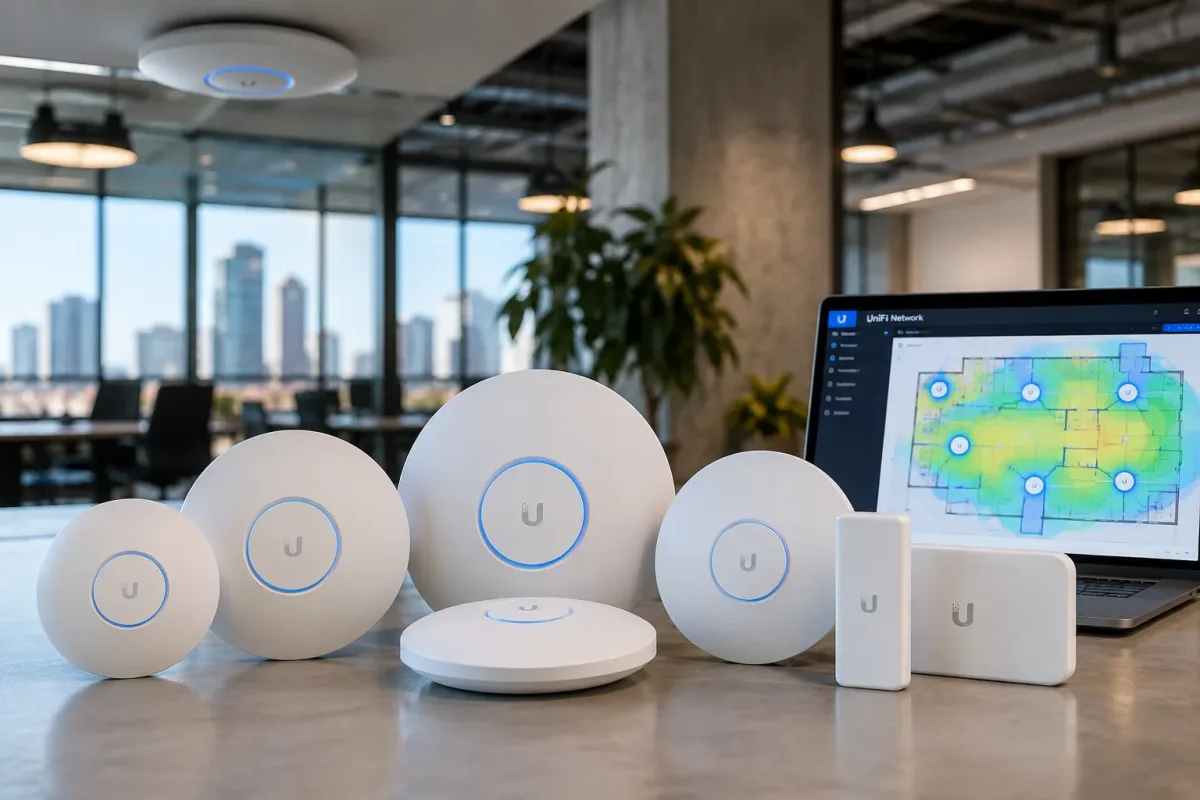
Every UniFi access point from the U6 generation onwards, 24 models in 27 antenna configurations, ranked on what decides a real installation: how far a phone keeps a good signal in each direction, how strong that signal is from 10 to 150 metres and the link speed it supports, how many people each unit carries comfortably, how well it finds and dodges interference, and what it costs.
The short version
Ceiling units are closely matched
In a UK office on 5 GHz every ceiling unit reaches an iPhone 17 Pro at 20–21 m all round, and a matching unit at 24–29 m. The phone's 200 mW and Ofcom's 1 W cap run out within 2 dB of each other, so even the £79 models give up little reach.
6 GHz is quiet but short
Ofcom's 0.25 W indoor limit costs reach. A U7 Pro holds −67 dBm to a phone 13 m away all round on 6 GHz, against 21 m on 5 GHz. Use 6 GHz to add capacity in busy rooms, not to stretch coverage.
Dodging interference needs a scanning radio
Only the U7 Pro Max, U7 Pro XGS and the E7 family add a dedicated spectral-scanning radio with zero-wait DFS. They score 8.5–10 on our interference scale; every other model scores 3–6.
The cheapest way in
The U6+ and U7 Lite both list at £79 ex VAT with the same reach, 20 m all round. The U7 Lite is the Wi-Fi 7 option for the same money.
Figures are for the UK on 5 GHz in a typical office, with reach measured to −67 dBm, unless stated otherwise.
The ranking table
Choose a region, band and building type, then click any column heading to rank by it; click it again to reverse the order. Each reach cell gives two distances at −67 dBm: to an iPhone 17 Pro on the left and to a matching access point on the right, which is the range for a wireless mesh link. Use Rank reach by to choose which one the reach columns sort on. Every figure is modelled from Ubiquiti's published specifications and the regulators' power limits rather than measured on site, and italic figures rest on an estimated antenna pattern, explained in the note below the table.
Showing 27 configurations for the UK on 5 GHz in a typical office, ranked by 360° reach to an iPhone, longest first.
Switching region, band or building and re-sorting the columns need JavaScript.
| Model | Reach at −67 dBm, metresiPhone / matching access point | Signal to an iPhone 17 Pro (%) and link speed (Mbps) | Safe usersactive at once | Interference IQout of 10 | Price£ ex VAT | |||||||
|---|---|---|---|---|---|---|---|---|---|---|---|---|
| 360° | 180° | Up | Down | 10 m | 20 m | 50 m | 100 m | 150 m | ||||
1U6 Mesh ProWi-Fi 6 omni, 2×2 at 8 dBi | 32/67 | 33/72 | 2/1 | 3/3 | 80%961 | 62%576 | 38%144 | 20%17 | 10%no link | 40max 250+ | 3Base only | £159 |
1U7 Pro Outdooromni antennasWi-Fi 7 omni, 2×2 at 8 dBi6 GHz stays on the built-in panel | 32/67 | 33/72 | 2/1 | 3/3 | 80%961 | 62%576 | 38%144 | 20%17 | 10%no link | 40max 300+ | 4.5MLO | £220 |
3U7 MeshWi-Fi 7 omni, 2×2 at 6 dBiOmni mode shown; directional mode not modelled | 30/57 | 31/62 | 2/1 | 3/3 | 80%961 | 62%576 | 38%144 | 20%17 | 10%no link | 40max 200+ | 4.5MLO | £159 |
4U6 MeshWi-Fi 6 omni, 4×4 at 5 dBi | 28/53 | 29/57 | 2/1 | 3/3 | 80%961 | 62%576 | 38%144 | 20%no link | 10%no link | 50max 250+ | 3Base only | £140 |
5U7 Outdooromni antennasWi-Fi 7 omni, 2×2 at 4 dBi | 26/49 | 27/53 | 2/1 | 3/3 | 80%961 | 62%576 | 38%144 | 20%no link | 10%no link | 40max 250+ | 4.5MLO | £159 |
6E7Wi-Fi 7 ceiling, 4×4 at 6 dBi | 21/29 | 23/33 | 3/5 | 7/6 | 74%721 | 56%432 | 32%72 | 14%no link | 4%no link | 100max 1,000+ | 9.5Scan, ZW-DFS, MLO, 6 GHz | £395 |
6U6 ProWi-Fi 6 ceiling, 4×4 at 6 dBi | 21/29 | 23/33 | 3/5 | 7/6 | 74%721 | 56%432 | 32%72 | 14%no link | 4%no link | 50max 250+ | 3Base only | £125 |
6U7 Long-RangeWi-Fi 7 ceiling, 3×3 at 6 dBi | 21/29 | 23/33 | 3/5 | 7/6 | 74%721 | 56%432 | 32%72 | 14%no link | 4%no link | 45max 300+ | 4.5MLO | £125 |
6U7 ProWi-Fi 7 ceiling, 2×2 at 6 dBi | 21/29 | 23/33 | 3/5 | 7/6 | 74%721 | 56%432 | 32%72 | 14%no link | 4%no link | 75max 300+ | 6MLO, 6 GHz | £140 |
6U7 Pro MaxWi-Fi 7 ceiling, 4×4 at 6 dBi | 21/29 | 23/33 | 3/5 | 7/6 | 74%721 | 56%432 | 32%72 | 14%no link | 4%no link | 85max 500+ | 9.5Scan, ZW-DFS, MLO, 6 GHz | £220 |
6U7 Pro XGSWi-Fi 7 ceiling, 4×4 at 6 dBi | 21/29 | 23/33 | 3/5 | 7/6 | 74%721 | 56%432 | 32%72 | 14%no link | 4%no link | 85max 500+ | 9.5Scan, ZW-DFS, MLO, 6 GHz | £239 |
12U6 Long-RangeWi-Fi 6 ceiling, 4×4 at 5.5 dBi | 20/28 | 22/32 | 3/4 | 6/6 | 74%721 | 56%432 | 32%72 | 14%no link | 4%no link | 50max 350+ | 3Base only | —not listed |
12U6 EnterpriseWi-Fi 6E ceiling, 4×4 at 5.3 dBi | 20/27 | 22/32 | 3/4 | 6/6 | 74%721 | 56%432 | 32%72 | 14%no link | 4%no link | 100max 600+ | 4.56 GHz | £220 |
12U7 Pro XGWi-Fi 7 ceiling, 2×2 at 5 dBi | 20/27 | 21/31 | 3/4 | 6/6 | 74%721 | 56%432 | 32%72 | 14%no link | 4%no link | 75max 300+ | 6MLO, 6 GHz | £159 |
12U7 LiteWi-Fi 7 ceiling, 2×2 at 5 dBi | 20/25 | 21/29 | 3/4 | 6/5 | 72%721 | 54%432 | 30%72 | 12%no link | 2%no link | 40max 200+ | 4.5MLO | £79 |
12U6+Wi-Fi 6 ceiling, 2×2 at 5.4 dBi | 20/24 | 22/28 | 3/4 | 6/5 | 71%721 | 53%432 | 29%72 | 11%no link | 1%no link | 40max 300+ | 3Base only | £79 |
17U7 In-WallWi-Fi 7 wall, 2×2 at 8 dBi | 11/8 | 23/33 | 5/6 | 6/6 | 78%865 | 60%432 | 36%144 | 18%17 | 8%no link | 40max 200+ | 4.5MLO | £119 |
17U6 ExtenderWi-Fi 6 plug-in, 4×4 at 6 dBiWireless uplink only | 11/7 | 21/29 | 4/5 | 6/6 | 78%865 | 60%432 | 36%144 | 18%no link | 8%no link | 30max 250+ | 3Base only | —not listed |
17U6 In-WallWi-Fi 6 wall, 4×4 at 5.9 dBi | 11/7 | 21/28 | 4/5 | 6/6 | 78%865 | 60%432 | 36%144 | 18%no link | 8%no link | 50max 250+ | 3Base only | £140 |
17U7 Pro XG WallWi-Fi 7 wall, 2×2 at 6 dBi | 11/7 | 21/29 | 4/5 | 6/6 | 78%865 | 60%432 | 36%144 | 18%no link | 8%no link | 75max 300+ | 6MLO, 6 GHz | £220 |
21U6 Enterprise In-WallWi-Fi 6E wall, 4×4 at 5.8 dBi | 10/7 | 21/28 | 4/5 | 6/6 | 78%865 | 60%432 | 36%144 | 18%no link | 8%no link | 100max 600+ | 4.56 GHz | £239 |
21U7 Pro WallWi-Fi 7 wall, 2×2 at 5 dBi | 10/7 | 20/27 | 4/5 | 5/6 | 78%865 | 60%432 | 36%144 | 18%no link | 8%no link | 75max 300+ | 6MLO, 6 GHz | £159 |
23E7 Audience90° modeWi-Fi 7 directional, 4×4 at 11 dBi | 8/6 | 14/17 | 3/4 | 5/5 | 80%961 | 62%576 | 38%144 | 20%17 | 10%no link | 130max 1,500+ | 10Scan, ZW-DFS, MLO, 6 GHz, PRISM | £1,590 |
23U7 Pro Outdoorbuilt-in panelWi-Fi 7 outdoor panel, 2×2 at 11 dBi | 8/6 | 14/17 | 3/2 | 3/3 | 80%961 | 62%576 | 38%144 | 20%17 | 10%no link | 40max 300+ | 4.5MLO | £220 |
23E7 CampusWi-Fi 7 directional, 4×4 at 12 dBiE7 Campus Indoor has the same radios | 8/5 | 17/26 | 2/2 | 3/3 | 80%961 | 62%576 | 38%144 | 20%17 | 10%no link | 50max 1,000+ | 8.5Scan, ZW-DFS, MLO, PRISM | £635 |
26U7 Outdoorbuilt-in panelWi-Fi 7 outdoor panel, 2×2 at 12.5 dBi | 7/5 | 7/5 | 2/2 | 3/3 | 80%961 | 62%576 | 38%144 | 20%17 | 10%no link | 40max 250+ | 4.5MLO | £159 |
27E7 Audience50° modeWi-Fi 7 directional, 4×4 at 15 dBi | 6/4 | 6/4 | 2/1 | 3/3 | 80%961 | 62%576 | 38%144 | 20%17 | 10%no link | 130max 1,500+ | 10Scan, ZW-DFS, MLO, 6 GHz, PRISM | £1,590 |
- 80% or more: excellent, −50 dBm or better
- 60–79%: very good
- 47–59%: good, fine for calls and video
- Under 47%: weak, below −67 dBm
- 12Italic: estimated antenna pattern
- Reach: iPhone / matching access point, in metres (k = thousand). Up and Down: reach 90° above and below the strongest direction, through floors; blank outdoors. Small figure under each signal: link speed in Mbps. Scan: dedicated spectral-scanning radio. ZW-DFS: zero-wait DFS. MLO: Wi-Fi 7 multi-link operation. PRISM: Ubiquiti's active RF filtering. Max: Ubiquiti's own maximum device count.
How the numbers are worked out
- Reach
The distance at which a link falls to −67 dBm, the usual design target for calls and video. The first figure is to an iPhone 17 Pro and takes whichever direction of the link is weaker, access point to phone or phone back to access point. The second is to a matching access point, the same model mounted the same way, which is the range to expect for a wireless mesh link. We compare the signal level itself with −67 dBm and give no extra credit for multiple antennas: MIMO combining helps a radio decode a weak signal, but it doesn't raise the level the target refers to. The Safety margin option takes 10 dB off every link to allow for fading, obstructions and interference, which cuts range to roughly a third in open air and a half in a typical office.
Indoors, loss starts from free space at 1 m for the band (2437, 5500, 6175 or 7000 MHz) and grows with distance at a rate set by the building: an exponent of 2.0 for open plan, 3.0 for a typical partitioned office and 3.5 for solid walls. Up and Down also cross floors, one every 3 m, using the office floor loss in ITU-R P.1238: 15 dB for the first floor and 4 dB for each one after. That is its figure for 1.8 to 2 GHz; floors cost more at 5 and 6 GHz, so treat vertical reach as a best case.
Outdoors we use the two-ray ground-reflection model: free-space loss out to a breakpoint of 4 × h1 × h2 ÷ wavelength, then 40 dB per decade, with the access point at the chosen mounting height (3 m unless you pick another), the phone at 1 m, about pocket height, and a mesh partner at the same height as the access point. Lower mounting pulls the breakpoint in sharply: with the access point at 1 m it sits only about 73 m from a phone on 5 GHz. It assumes a clear line of sight; trees, vehicles and people cut the range further. Indoor models are included outdoors as if fitted in a weatherproof enclosure, whose own loss isn't counted. Up and Down are left blank outdoors, since they describe coverage between floors. 6 GHz outdoors needs AFC in the US and is limited to 25 mW in the UK.
The access point's output is capped at the regional limit. On 5 GHz that assumes a DFS channel (100 to 140) in the UK and a U-NII-1 or U-NII-3 channel in the US, the highest-power options in each. The 360° and 180° columns give the reach you can count on across that whole arc, centred on the strongest direction; Up and Down look 90° above and below it. Directional panels concentrate their signal in a narrow beam, so their arc figures are short; their strength along the beam shows in the signal columns.
- Signal percentage
A straight-line scale from −90 dBm, which reads 1%, to −40 dBm or stronger, which reads 100%. On it the −67 dBm design target reads 47% and −75 dBm reads 31%. It is the signal a phone would see on the access point's strongest direction. Apple's deployment guidance puts an iPhone's roaming trigger at about −70 dBm, or 41%.
The phone is an iPhone 17 Pro at its published maximum transmit power for each country. In the UK, Apple's declaration for model A3523 lists under 100 mW on 2.4 GHz, under 200 mW on 5 GHz channels 100 to 140 and under 250 mW on 6 GHz. In the US, the FCC grant for BCG-E8949A lists 248 mW on 2.4 GHz and 199 mW on 5 GHz as conducted output, which we treat as radiated, and on 6 GHz 65 mW across 5955 to 7115 MHz and 218 mW in U-NII-5. The rules allow that higher 6 GHz figure only under standard-power operation, so we use it only with AFC-capable access points. These are maximums; the phone can transmit less, for example when held against the body.
Apple's declarations don't give antenna gain, so we assume 0 dBi plus 3 dB of hand and body loss in both directions: −3 dBi when the phone receives, and 3 dB off its published power when it transmits. Reach to a phone then ends wherever the weaker direction does, which the table works out for each model, band and country.
- Link speed
The small figure under each signal is the Wi-Fi link rate an iPhone 17 Pro could hold at that signal, in Mbps. It uses the minimum receiver sensitivities set by the 802.11ax and 802.11be standards, for two spatial streams (the iPhone 17 Pro has 2×2 MIMO) on a clean channel up to 20 MHz wide on 2.4 GHz, 80 MHz on 5 GHz and 160 MHz on 6 and 7 GHz. Wi-Fi 6 access points stop at 1024-QAM and Wi-Fi 7 at 4096-QAM. It reads "no link" once either direction falls below the slowest rate.
Current phones usually beat the standard's minimum sensitivities, and a speed test typically shows around 60 to 70% of the link rate, so treat the figure as a conservative link rate rather than a download speed.
- Safe users
Our planning figure for people actively using the network at once, on calls, video meetings and cloud apps, with headroom to spare. We allow 10 on 2.4 GHz; 30, 35 or 40 on a two-, three- or four-antenna 5 GHz radio; and 35 or 50 on a two- or four-antenna 6 GHz radio, counted only where the region lets that model use 6 GHz.
The U6 Extender's 5 GHz share is halved because the same radio carries its wireless uplink. The E7 Audience's 12 streams count as three four-antenna radios: one on 5 GHz and two on 6 GHz in the US, and two on 5 GHz and one on 6 GHz in the UK. The small figure under each result is Ubiquiti's maximum device count, which says how many devices can connect, not how many will get a good experience.
- Interference IQ
A 10-point score for finding and avoiding interference in real time. Every model starts at 3 for the channel optimisation and RF scanning built into UniFi Network. We add 2.5 for a dedicated spectral-scanning radio, which watches the airwaves continuously without taking a serving radio off its channel; 1 for zero-wait DFS, which clears a radar-protected channel in the background before moving to it; 1.5 for Wi-Fi 7 multi-link operation, which lets a client shift traffic between bands; 1.5 for a 6 GHz radio the region lets it use; and 0.5 for PRISM active RF filtering. The score rates capability, not measured performance.
- Price
UK figures are the Ubiquiti UK store's list prices before VAT. Its checkout adds VAT and a surcharge: the E7 Audience's £1,590 list price becomes £2,058. US figures are the US store's list prices before sales tax. Models not currently listed on either store show a dash.
2.4, 5, 6 and 7 GHz compared
The same access point behaves very differently from band to band, and the UK and US allow very different power. Reach to a phone ends where the weaker direction of the link does. In the UK the access point's signal usually runs out first on 2.4 GHz and 6 GHz and the phone's reply on 5 GHz; in the US the access point's signal usually runs out first on 2.4 GHz and the phone's reply on 5 GHz and 6 GHz. Switching the table to the US stretches reach to a phone on average by 79% on 2.4 GHz, 30% on 6 GHz and 9% on 5 GHz.
Maximum power allowed, in watts EIRP
- UK (Ofcom)
- US (FCC)
2.4 GHz goes furthest, with about 7 dB less loss than 5 GHz over the same distance, but has only three or four usable 20 MHz channels, shared with Bluetooth, microwave ovens and every neighbour. The UK caps it at 0.1 W, so here 5 GHz reaches about as far.
5 GHz is the workhorse. The UK allows 1 W on channels 100 to 140 (5470 to 5725 MHz), ten times the 2.4 GHz limit, but they are DFS channels: an access point must listen for radar before using one and leave if it hears any. Zero-wait DFS uses the scanning radio to clear the next channel in the background.
6 GHz carries only Wi-Fi 6E and Wi-Fi 7 devices, so it is quiet. The UK allows 0.25 W indoors in 5925 to 6425 MHz. The US allows about 0.5 W indoors on a 160 MHz channel across 5925 to 7125 MHz, and up to 4 W on U-NII-5 and U-NII-7 under AFC, which in this table means the E7 family and the U7 Pro Outdoor.
7 GHz isn't a separate band: it is the upper half of 6 GHz (6425 to 7125 MHz), reached by the same radios. The US allows all of it indoors. Ofcom's July 2026 decision opens 6425 to 6585 MHz on the same indoor terms as the lower band but allows Wi-Fi above 6585 MHz only under AFC, which UniFi supports only in the US and Canada. We model 7000 MHz, so the UK view is empty.
UK or US: a U7 Pro at 40 metres
The same U7 Pro, 40 metres from an iPhone 17 Pro in a typical office, with both set up for the UK or for the US, on all four bands. Each phone uses its published maximum power for its country: 100 mW in the UK against 248 mW in the US on 2.4 GHz, about 200 mW in both on 5 GHz, and on 6 GHz 250 mW in the UK against 65 mW in the US, where a phone stays at low power indoors unless the access point runs standard power under AFC.
Signal at 40 metres, per cent
- UK
- US
- 47%: −67 dBm, good for calls and video
Download: access point to phone
Upload: phone to access point
Range that holds −67 dBm, metres
2.4 GHz. Download: UK −74 dBm (52 Mbps), US −67 dBm (103 Mbps); upload: UK −70 dBm (69 Mbps), US −66 dBm (103 Mbps). The UK's 0.1 W cap costs 7 dB. The US iPhone sends 4 dB more.
5 GHz. Download: UK −71 dBm (144 Mbps), US −69 dBm (216 Mbps); upload −72 dBm (144 Mbps) in both. Ofcom's 1 W cap costs 2 dB.
6 GHz. Download: UK −78 dBm (34 Mbps), US −75 dBm (72 Mbps); upload: UK −73 dBm (144 Mbps), US −78 dBm (34 Mbps). The UK's 0.25 W indoor limit costs 3 dB. The US iPhone sends 6 dB less.
7 GHz. Not available to UniFi in the UK: Ofcom allows it only under AFC, which UniFi supports only in the US and Canada. US: download −76 dBm (52 Mbps), upload −80 dBm (17 Mbps).
Setting the U7 Pro up for the US adds 7 dB on 2.4 GHz, 2 dB on 5 GHz and 3 dB on 6 GHz to its download at 40 metres, and opens 7 GHz, which UniFi can't use in the UK yet. On upload, the US iPhone 17 Pro sends 4 dB more on 2.4 GHz and 6 dB less on 6 GHz. The phone's upload is the weaker leg on 5 GHz, 6 GHz and 7 GHz. Every band still connects at 40 metres, but 6 and 7 GHz download at only 34–72 Mbps, against 52–216 Mbps on 2.4 and 5 GHz. In a typical office the U7 Pro holds −67 dBm to 23–39 m on 2.4 and 5 GHz and 15–17 m on 6 and 7 GHz, so at 40 metres every band has dropped below the calls-and-video target.
Point-to-point links: Ubiquiti bridges compared
A point-to-point bridge links two buildings or sites with a matched pair of radios. This table ranks Ubiquiti's UniFi bridges and its most-used airMAX 5 GHz radios on how far a pair reaches at full speed and at 100 Mbps, what the link realistically carries from 0.5 to 10 km, how high each end must sit to keep the path clear, and what the same link manages with both ends only 2 m off the ground. Every range assumes two of the same model aimed at each other.
Showing 9 radios for the UK with a 10 dB safety margin, ranked by 100 Mbps range, longest first.
Switching region, margin or range and re-sorting the columns need JavaScript.
| Model | Band | Safe rangepair of the same model | Real throughput, Mbpsclear line of sight | Mountingfor the 100 Mbps range | Price£ ex VAT, each | ||||||
|---|---|---|---|---|---|---|---|---|---|---|---|
| Full speed | 100 Mbps | 0.5 km | 1 km | 2 km | 5 km | 10 km | Height needed | At 2 m high | |||
1airMAX LiteBeam 5AC Long-RangeLBE-5AC-LR, managed in UISP24 V passive PoE, adapter included | 5 GHz5470–5725 MHz, 1 W limitEIRP 30 dBm, 26 dBi | 760 m | 17 km | 450 | 405 | 337 | 270 | 135 | 13 m | 2.3 km | £85 |
2airMAX PowerBeam 5ACPBE-5AC-Gen2, managed in UISP24 V passive PoE, adapter included | 5 GHz5470–5725 MHz, 1 W limitEIRP 30 dBm, 25 dBi | 680 m | 15 km | 450 | 405 | 304 | 270 | 135 | 12 m | 2.1 km | £102 |
3airMAX LiteBeam 5ACLBE-5AC-Gen2, managed in UISP24 V passive PoE, adapter included | 5 GHz5470–5725 MHz, 1 W limitEIRP 30 dBm, 23 dBi | 540 m | 12 km | 450 | 337 | 304 | 202 | 101 | 9.7 m | 1.9 km | £52 |
4airMAX NanoBeam 5ACNBE-5AC-Gen2, managed in UISP24 V passive PoE, adapter included | 5 GHz5470–5725 MHz, 1 W limitEIRP 30 dBm, 19 dBi | 340 m | 7.6 km | 405 | 304 | 270 | 135 | 67 | 6.9 m | 1.5 km | £79 |
4Device Bridge ProUDB-Pro, managed in UniFiPoE, 48 V; PoE+ input for its PoE outputUbiquiti rating: 5+ km | 5 GHz5470–5725 MHz, 1 W limitEIRP 30 dBm, 19 dBi | 340 m | 7.6 km | 405 | 304 | 270 | 135 | 67 | 6.9 m | 1.5 km | £159 |
6Building Bridge XG5 GHz backup radioUBB-XG, managed in UniFiPoE++ or passive PoE, 29 W | 5 GHz5470–5725 MHz, 1 W limitEIRP 30 dBm, 14 dBi | 190 m | 4.3 km | 337 | 270 | 202 | 67 | 15 | 4.8 m | 1.1 km | £435 |
7Building Bridge5 GHz backup radioUBB, managed in UniFiPoE, 11 W, adapter included | 5 GHz5470–5725 MHz, 1 W limitEIRP 30 dBm, 10 dBi | 120 m | 2.7 km | 270 | 202 | 135 | 31 | no link | 3.7 m | 900 m | £220 |
–Building Bridge60 GHz main radioUBB, managed in UniFiPoE, 11 W, adapter includedUbiquiti rating: 1.7 Gbps up to 500 m | 60 GHz57–66 GHzEIRP 36.2 dBm, 17.2 dBi | — | — | — | — | — | — | — | 0.5 m | — | £220 |
–Building Bridge XG60 GHz main radioUBB-XG, managed in UniFiPoE++ or passive PoE, 29 WUbiquiti rating: 6 Gbps up to 500 m | 60 GHz57–66 GHzEIRP 37 dBm, 21 dBi | — | — | — | — | — | — | — | 0.5 m | — | £435 |
- Full speed: the longest link that keeps the top rate, about 450 Mbps of real throughput. 100 Mbps: the longest link that still carries 100 Mbps. Height needed: how high each end must sit above flat, open ground at the 100 Mbps range to keep 60% of the first Fresnel zone clear, plus the Earth's curve. At 2 m high: the 100 Mbps range with both ends only 2 m up, where the ground reflection takes over. Price is per radio; a link needs two. Italic: receiver figures assumed.
In the UK, Ofcom's 1 W limit covers the whole radio including its antenna, so a bigger dish only helps at the receiving end: with a 10 dB margin a pair of LiteBeam 5AC Long-Range radios carries 100 Mbps to 17 km here, against 184 km in the US, where point-to-point rules don't cap antenna gain. Mounting matters as much as the radio. Holding that UK link at full length needs each end about 13 m above flat ground to clear the Fresnel zone and the Earth's curve; with both ends at 2 m the same pair manages only 2.3 km.
Planning a UniFi rollout?
We design and install Ubiquiti networks for businesses in London, Kent and Sussex, with remote support across the US and worldwide. Read more about our network installation and Ubiquiti work.
Sources
- Ubiquiti, UniFi WiFi tech specs: antenna gain, transmit power, MIMO, beamwidths and maximum device counts for each model.
- Ubiquiti Store, UK and US: list prices.
- Ubiquiti, NanoBeam AC Gen2, LiteBeam AC Gen2 and PowerBeam AC Gen2 datasheets: gain, transmit power and receive sensitivity by modulation, and the 450+ Mbps throughput figure.
- Ubiquiti tech specs for the Building Bridge, Building Bridge XG and Device Bridge Pro; bridge prices from the UK and US stores and airMAX prices from the UK and US stores.
- Ubiquiti Help Center, AP Antenna Radiation Patterns, Regions Supporting 6 GHz and Multi-Link Operation (MLO) in UniFi Network.
- Ofcom, Expanding access to the 6 GHz band for commercial mobile and Wi-Fi services (statement, July 2026), and UK Interface Requirement IR 2030 for the 2.4 GHz and 5 GHz limits.
- FCC, Unlicensed use of the 6 GHz band (fact sheet), and 47 CFR Part 15 for the 2.4 GHz and 5 GHz limits.
- IEEE 802.11ax-2021 and 802.11be-2024: receiver minimum input sensitivity and data rates used for the link-speed figures.
- Apple, iPhone 17 regulatory information (UK): maximum Wi-Fi power declared for models including A3523, the UK iPhone 17 Pro.
- FCC, FCC ID BCG-E8949A: equipment authorisation for the iPhone 17 Pro (A3256, A3522, A3523, A3524), including Wi-Fi output power and channel widths.
- Apple, iPhone 17 Pro tech specs: Wi-Fi 7 with 2×2 MIMO.
- Apple, Wi-Fi roaming support in Apple devices.
Specifications and prices checked on 19 September 2026. Prices change often, so check the store before you buy.