They warned businesses about AI cyber attacks but nobody will listen until its too late..
NCSC and FBI warnings on AI-driven cyber attacks continue, yet patch data shows most businesses remain unprepared. See what UK/US firms must do now. Sometimes its impossible to fix a mind set and the hard lessons need to be learnt.
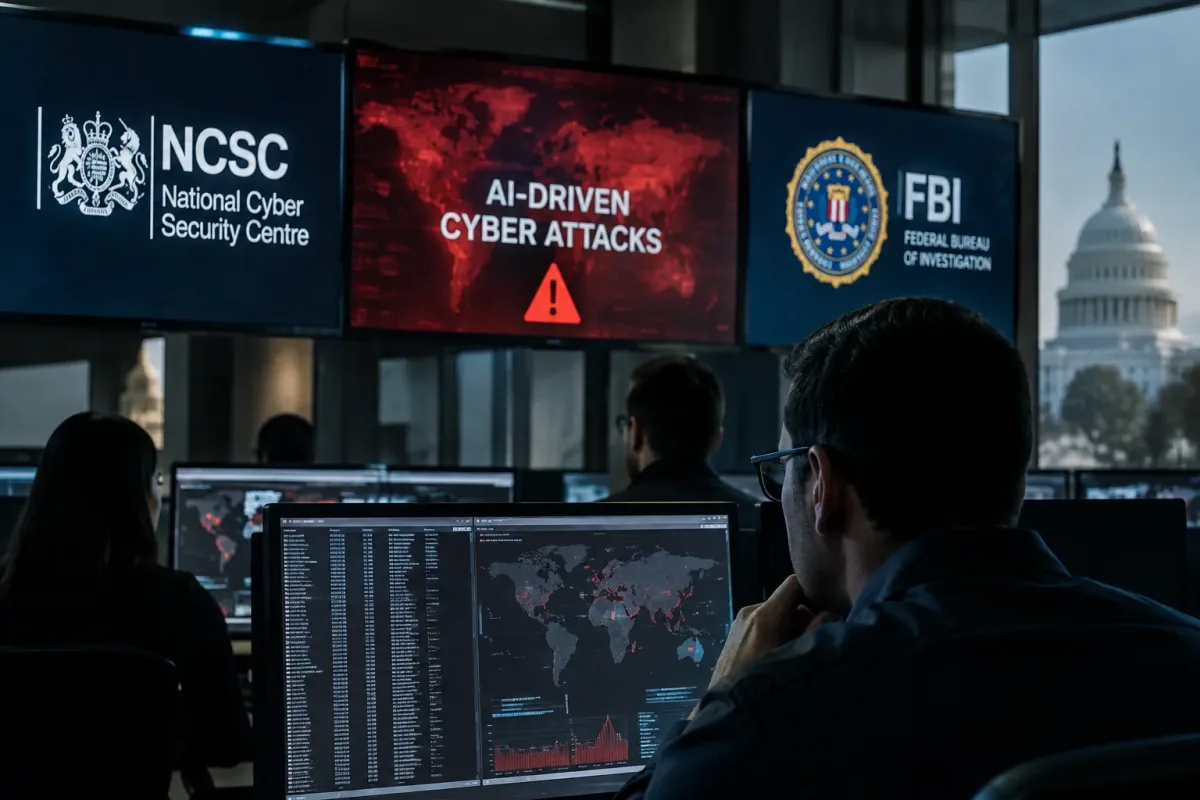
In the two weeks since the UK's cyber security chief warned that businesses were wilfully blind to the risk, the threats have only grown. A flaw in the language that runs most of the web is being exploited, a trusted website tool served malware to visitors of the BBC, CNN, Zoom and HSBC, and both Chrome and Outlook needed emergency fixes. Despite every alert, the evidence suggests most business owners have done little to strengthen their security.
Two weeks of cyber warnings, and little has changed
On 3 November, Richard Horne, chief executive of the National Cyber Security Centre (NCSC), warned that the UK faced the real prospect of an unprecedented rise in cyber incidents in the coming months. He told businesses to stop being "wilfully blind" to the risk. In the fortnight since, the NCSC, the FBI and the US cybersecurity agency CISA have issued further warnings, and vendors have shipped emergency fixes almost daily.
The signs of action are thin. Check Point had made a PHP2Shell fix available for its firewalls from 23 October, yet between 30 October and 4 November attackers broke into internet-facing Check Point gateways that still hadn't been updated, so even security devices were left unpatched. On 12 November, attackers took over IT management servers within hours of an exploit being published. When the Optimizely attack hit on 16 November, Report URI found 68 of the affected organisations had no Content Security Policy at all, one of the basic protections against exactly this kind of attack.
No survey has yet measured what business owners did over the last fortnight. But nothing in the attacks, the patch data or the official surveys below suggests that most businesses have used these two weeks to improve their security.
Is this a cyber war? What the last month of attacks shows
"Cyber war" sounds like a headline writer's phrase, but the UK's own security agency is now describing something close to it. In its Annual Review, published on 3 November 2026, the National Cyber Security Centre (NCSC) said hostile states, Russia and China among them, now routinely use AI-enabled cyber operations to pursue geopolitical goals. Cyber attacks were part of the opening phase of the 2026 Iran war. A destructive attack on Poland's power grid in December 2025 has been linked by experts to Moscow.
The bigger change is speed. Flaws are being found faster, exploited before patches exist, and pushed out to thousands of targets at once through software that businesses trust. Below are the incidents that matter most to UK and US businesses right now, and what to do about them.
PHP2Shell: the critical PHP vulnerability affecting most of the web
PHP2Shell is the name for two critical flaws, CVE-2026-109618 and CVE-2026-109619, in PHP itself. Both are rated 9.2 (critical) and let an attacker run code on a web server without logging in. Because the flaw is in the PHP runtime rather than any one application, sites built on WordPress, Drupal, Joomla and countless custom systems are exposed if the server underneath is not patched.
Details became public on 20 October, ahead of the planned disclosure. The PHP Project released fixed versions the next day: 8.5.12, 8.4.27, 8.3.36 and 8.2.35. PHP 8.1 and older are end-of-life and get no fix at all. Amazon's threat intelligence team recorded an exploitation attempt on 17 October, before the flaw was even public. Working exploit code has since appeared on GitHub, and some of it is being used to install botnet malware.
This was one of the most widely reported vulnerabilities of the year. Here is how the internet responded:
Bitsight found that nearly half of all vulnerable hosts run PHP 7 or older, versions that went out of support years ago. Those servers were already years behind on updates before PHP2Shell arrived. If your website runs on PHP and you don't know which version, find out today, or ask us to check it as part of our website maintenance service.
The Optimizely attack: malware served through a trusted website tool
On 16 November, an attacker exploited a flaw in Optimizely Web Experimentation, a tool that large websites use to test page changes, and planted malicious JavaScript in customers' projects. Because the code was delivered from Optimizely's own servers, with its own certificate, every website and browser treated it as trusted. The affected sites never had their own code touched.
Scott Helme of Report URI, who uncovered the attack, examined 1,611 Optimizely scripts and found 188 infected ones belonging to 178 organisations, including the BBC, CNN, Zoom, HSBC, IKEA, Salesforce and Equifax. The code skimmed payment cards, swapped cryptocurrency wallet addresses when visitors copied them, and tried to deliver exploit kits to iPhones and iPads running older versions of iOS. Optimizely says it has fixed the flaw and removed the injected code.
The detail that should worry every business with a website: Report URI found that only 24 of the affected organisations, about 15%, had a Content Security Policy strict enough to block the attack, and 68 had no policy at all. A policy that simply trusted Optimizely's domain offered no protection, because the malware came from that domain. Every third-party script on your site, whether analytics, chat, testing or advertising, runs with the same trust as your own code.
Chrome, Outlook and Windows zero-days, and an attack on IT management tools
Alongside PHP2Shell and Optimizely, November brought a run of flaws that were being exploited before or as fixes arrived.
Chrome and Edge
On 9 November, Google fixed CVE-2026-125350, a high-severity flaw in Chrome's XML handling that was already being exploited. It is the eighth exploited Chrome zero-day of 2026. A crafted web page is enough to trigger it, and it affects other Chromium-based browsers, including Microsoft Edge. Chrome 157.0.8103.50 or later contains the fix. The US cybersecurity agency CISA has given federal agencies until 24 November to patch.
Outlook and Windows
Microsoft's November updates fixed more than 1,000 vulnerabilities, after a record release in October. One of them, CVE-2026-124194 in classic Outlook for Windows, is being actively exploited: opening a specially crafted message file can make Outlook send the user's Windows login hash to an attacker's server without the usual warning. Separately, a researcher has published working exploit code, dubbed SignDrop, that claims to let any local Windows user gain full SYSTEM control. Microsoft has not confirmed it or released a fix, and no attacks using it have been reported yet.
The tools that manage your IT
The incident with the widest potential reach hit N-able N-central, a platform many IT providers use to manage their clients' computers. Exploit code for a flaw called 4EverAble2Shell was published on 12 November. Within about four and a half hours, attackers had taken over 21 N-central servers and installed cryptocurrency miners. Nineteen of those 21 were already running the latest security hotfix. A miner is the mild outcome: a server like that can push software to every machine it manages, across every client.
NSA, bank and Microsoft outages: attack or failure?
The same fortnight brought a wave of outages. Microsoft 365, including Outlook and Teams, went down on 12 and 13 November. The US aviation regulator, the FAA, grounded flights nationwide on 13 November. Chase customers couldn't reach their accounts on 16 November, with complaints at Bank of America, Wells Fargo and US Bank too. On 17 November the NSA's internal classified network, NSANet, went down, and Apple services had problems the same day.
So far, none of these has been confirmed as a cyber attack. Microsoft blamed a network capacity upgrade, Chase a software bug in its own hardware, and the NSA scheduled maintenance. The FAA says it found no sign of an attack. The viral claims of a global blackout on 17 November were a hoax built around a routine US emergency alert test.
That shouldn't reassure anyone. For a business that loses email, payments or its line-of-business system for a day, it makes little difference whether the cause was a hostile state or a botched upgrade. And criminals move in either way: during the Microsoft outage, the NCSC warned UK businesses about scam calls from people pretending to be IT helpdesks.
Government cyber warnings: prepare, back up and plan for power cuts
The official warnings are unusually direct.
- The NCSC handled 80 nationally significant incidents in its latest year and alerted around 8,500 organisations to suspected compromises. It judges that a ransomware attack using AI-powered malware against UK critical infrastructure is highly likely by 2028. It found that 88% of incidents at large organisations began through just four routes: exposed public-facing applications, phishing, stolen or misused logins, and remote access services. It is urging organisations to prepare for a wave of patches and to treat Cyber Essentials as a starting point, not the finish line.
- The FBI warned on 13 November that criminals and state-linked groups are using ARTEX, an AI-driven penetration testing tool, to automate attacks. In some cases they went from first contact to privileged access in under three hours. The FBI's first recommendation is to find and shrink everything you have exposed to the internet.
- The UK government relaunched its Be Ready campaign on 22 October, asking households to be able to manage for up to 72 hours without normal services, including power, water, phones and the internet. Several European countries give similar three-day advice. The government says a national blackout is unlikely, but the advice applies just as much to a business: could you trade for three days without power or connectivity?
How many businesses act on a cyber security review?
Patching one well-publicised flaw was a simple test, and most organisations failed it. The wider record of how businesses review and fix their security is no better.
Most businesses never have a security review
The UK government's Cyber Security Breaches Survey 2025/26 asked 2,112 businesses what they actually do. In the year studied, 43% suffered a breach or attack. Yet only 30% carried out a cyber risk assessment, 18% a vulnerability audit and 13% a penetration test. Only 25% have a formal incident response plan. Just 15% review the security of their immediate suppliers, and 6% their wider supply chain, which is exactly where the Optimizely and N-central attacks came from. Only 47% use any form of two-factor authentication, which leaves more than half relying on passwords alone.
Security reviews that end up in a drawer
Ordering a review is not the same as acting on it. Cobalt, which runs penetration tests for thousands of organisations, found that only 48% of all findings were ever recorded as fixed, and even among the most serious findings the figure was just 69%. These are organisations that paid specialists to find their weaknesses. In Cobalt's 2026 report, 57% of executives believed their organisation consistently fixed findings on time, but only 15% of the security staff doing the work agreed. Astra found that 22% of its customers tested once and never came back.
No survey tracks, as a single figure, how many smaller businesses commission a review and then complete every fix. Put the numbers together, though, and the pattern is clear: fewer than one UK business in five has had a vulnerability audit, and organisations that do get tested typically leave around half of the findings unfixed.
Why businesses decide to do nothing
The reasons are rarely technical. In a 2025 Coalition study, 79% of small businesses had been attacked at least once in five years, yet 64% still did not think they were an attractive target, and 59% thought their security spending was about right. StrongDM found that 47% of businesses with fewer than 50 staff spend nothing at all on cyber security, and 59% of owners with no security in place believe they are too small to be attacked but Q4 2026 has shown that every is at high risk.
Warnings arrive every week and start to sound like background noise. Outages are blamed on "a bug" and forgotten. Patching takes time and can break things, so it waits for a quiet week that never comes. The NCSC's chief executive, Richard Horne, has blamed decades of running technology on the cheap.
Old systems, weak logins and untested backups
The same gap shows up in the basics. Windows 10 support ended in October 2025, yet in July 2026 Lansweeper found it still running on 21.4% of Windows PCs in small and mid-sized businesses. Lansweeper's analysis also found that the average Windows 10 device carries nearly three times as many known vulnerabilities as a Windows 11 machine. In the government survey, only 19% of businesses had trained staff on cyber security in the previous year, and around one in four had no network firewall or secure cloud backup.
A business that skipped the review, shelved the findings or decided it was probably fine is just as exposed today as it was before PHP2Shell, Optimizely and this month's zero-days. For most, what finally forces action is being hit. The cost of that lesson is lost trading, lost data, notifying customers and regulators, and sometimes the business itself. Everything in the next section is cheaper than that.
What your business should do this week
None of this needs a large budget. It needs someone to own it and do it now.
If you'd rather hand this to specialists, our cyber security team covers patching, monitoring and ThreatDown endpoint protection, PCArmour Pro takes care of security on your PCs, and our data recovery service is there if the worst happens. If you think you've already been compromised, call our cyber security helpline.
Not sure where your business stands?
Speak directly to a senior engineer, not a call centre, about your patching, backups and exposure.