Goodbye Adobe! New free, open-source Adobe looking alternatives for Windows, Mac and Linux
At the turn of October 2026, a project called ArtCraft published free, open-source rebuilds of seven Adobe flagships: Photoshop, Illustrator, Premiere Pro, Lightroom, Acrobat, After Effects and InDesign. They are early, rough in places and not ready for client work, but they are the first serious crack in Adobe's grip on professional creative software that businesses should be watching.
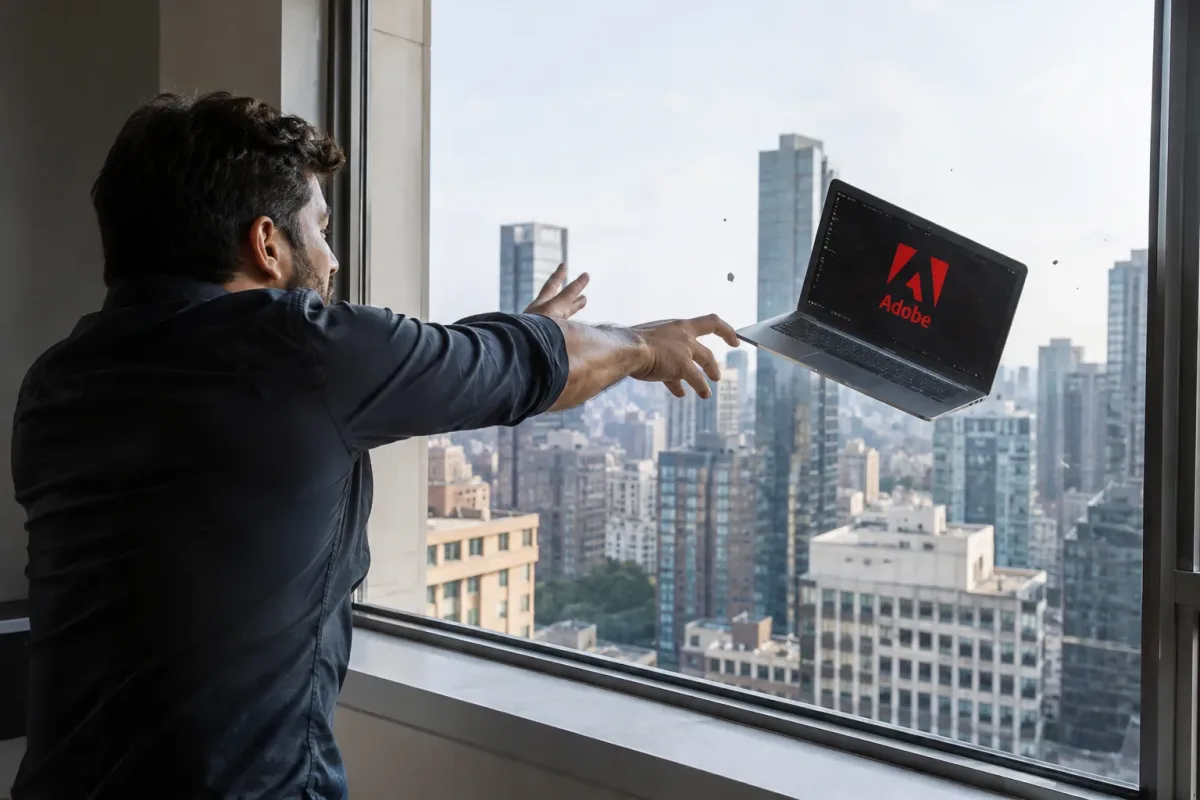
The seven apps (PhotoCraft, VectorCraft, FilmCraft, LightCraft, PrintCraft, EffectCraft and DesignCraft) are written from scratch in Rust, released under the MIT or Apache-2.0 licence, and ship native builds for macOS, Windows and Linux, with several also running on FreeBSD and in a web browser. There is no account, no subscription and, according to the projects themselves, no telemetry. Their developer, Brandon Thomas, says they were built with Anthropic's Claude Opus 5.5 AI model. All seven are free to download from getartcraft.com.
The video below shows the apps in use.
Why Adobe should be paying attention
Adobe's subscription model has irritated creative professionals for years. Earlier in 2026 the company agreed a $150 million settlement with US federal authorities over allegations that it trapped customers in hard-to-cancel plans, and Thomas has said his own run-in with Adobe's cancellation fees helped motivate the project. In the US, Adobe's Photography plan lists at $19.99 a month on an annual contract, and the full Creative Cloud Pro suite at $69.99 a month.
There is also a platform gap. Adobe sells none of these programs for Linux. Every ArtCraft app ships native Linux packages, which makes them a realistic option for organisations that have standardised on Linux desktops.
The bigger story is how the apps were made. Each repository carries instruction files for AI coding agents, and the documentation explains that demo projects and screenshots were produced by agents driving the running apps. Phoronix noted that the project appears to rely predominantly on AI and had already shipped several releases within a week of debuting. EffectCraft, the After Effects rebuild, records its first commit as 1 October 2026, yet already lists 306 effects. Its team is careful to add that behaviour hasn't yet been measured against After Effects, but the pace alone shows how quickly the cost of building serious creative software is falling.
Where each app stands today
PhotoCraft, the Photoshop rebuild
Stage: early alpha.
It already covers a lot of ground: layers, masks, 16 adjustment layers, layer styles, editable type, vector shapes, 34 tools and a brush engine that responds to pen pressure and tilt. It opens and saves real PSD and PSB files at 8, 16 and 32 bits per channel in RGB, greyscale, CMYK and Lab, with ICC colour management and soft proofing. Re-saving keeps the render of 307 of the 309 files in the psd-tools test set. The gaps the team lists are generative AI features, around twenty missing tools, depth in typography and professional workflows, and plug-in compatibility. Every Photoshop menu item is wired to a command, but the team stresses that this measures wiring, not behaviour.
LightCraft, the Lightroom rebuild
Stage: young and moving fast; listed as in development on ArtCraft's site.
LightCraft pairs a photo library with a non-destructive raw developer running in a 32-bit floating-point pipeline. It has its own decoders for DNG, Canon CR2, Sony ARW, uncompressed Nikon NEF, Fujifilm RAF (including X-Trans), Panasonic RW2, Pentax PEF and Olympus ORF. Albums, ratings, stacks, virtual copies, masking, HDR and panorama merging, and XMP sidecars all work today. Canon CR3 and compressed NEF, RAF and ORF files are still in progress and open only as embedded previews, subject and sky masks use classical heuristics rather than AI for now, and AI Denoise and Super Resolution haven't been started. It follows the cloud-first Lightroom rather than Lightroom Classic.
VectorCraft, the Illustrator rebuild
Stage: in active development; the team estimates 69–75% of Illustrator's features exist and work, and 40–55% are at the level where a power user couldn't tell the difference.
Drawing and path tools, Pathfinder and Shape Builder, gradients and gradient mesh, the perspective grid, multiple artboards and threaded type are in place, with SVG, PDF, PDF-compatible .ai, EPS and DXF support. Still missing are 3D and materials, the raster Effect Gallery, vertical CJK composition, variables and scripting, and a fidelity pass over every tool's modifier keys. The team is clear that its percentages are self-assessed.
FilmCraft, the Premiere Pro rebuild
Stage: about 87% of Premiere's feature checklist by the team's count, but only 50–60% ready for real work.
FilmCraft is the most technically ambitious of the set. Its H.264, HEVC, ProRes and AAC codecs are its own, written from the public specifications with no FFmpeg inside. Three-point editing, the full set of trims, a Lumetri-style colour panel with scopes, broadcast loudness metering and captions all work, and timelines move in and out through FCP7 XML, FCPXML, OpenTimelineIO, EDL, AAF and OMF. The gaps are performance on big footage (hardware decoding is macOS-only so far, and colour, keying and export still run on the CPU), no VST3, Audio Unit or OpenFX plug-ins, H.264 as the only delivery codec for export, and limited testing on real camera files and on Windows and Linux.
EffectCraft, the After Effects rebuild
Stage: the youngest of the set; its team says it isn't yet a replacement for After Effects on client work.
Compositions, layers, keyframes with a Graph Editor, JavaScript expressions using the After Effects object model, shape layers, masks, puppet tools, 3D cameras and lights, and a render queue are all present, along with built-in Lottie import and export. It cannot open .aep or .aepx project files, After Effects plug-ins don't run, nothing yet compares its renders with After Effects automatically, and Windows and Linux users have hit basic interaction bugs.
DesignCraft, the InDesign rebuild
Stage: in development.
The typesetting core is impressive: spreads and parent pages, threaded text frames, paragraph and character styles, CMYK swatches, text wrap, and a Knuth–Plass paragraph composer with hyphenation and optical margin alignment. It imports and exports IDML. The significant gap is output: it exports PNG today, and PDF export is still on the roadmap, which rules it out for print and publishing work for now.
PrintCraft, the Acrobat rebuild
Stage: early alpha (listed as PdfCraft on ArtCraft's website). The team estimates about half of Acrobat Pro's offline features are in place, including 88% of the must-haves, but reckons that represents only a third of the work.
Viewing and search, organising, combining and splitting, comments, form filling, password protection from 40-bit RC4 to AES-256, redaction, basic digital signatures, printing and an accessibility checker all work. Across the 983-file pdf.js test corpus, 963 files open and render cleanly with no crashes. Still missing are reliable editing of existing text, OCR beyond Latin scripts, Office import and export, signature timestamps and long-term validation, PDF/A, PDF/X and PDF/UA preflight, and XFA forms. Page rendering is still borrowed from a third-party library while the team builds its own, and fuzzing continues to turn up crashes and hangs on hostile files.
What early testers are saying
Hands-on reports match the projects' own candour. Gizmodo's Mike Pearl put together a quick composite in PhotoCraft and found every command where he expected it, although Free Transform behaved unpredictably and at times undid itself.
It feels like using glitchy, but real, Photoshop.
The Hacker News launch thread was harsher, with complaints aimed mostly at PhotoCraft: lag, frozen tools and keyboard shortcuts that didn't respond. One LightCraft tester was more positive about it for an early build but asked for masking fixes, according to PhotographyTalk. HotHardware likewise reported glitches, unpredictable tool behaviour and performance hiccups. Thomas originally aimed for full feature parity within a month; he now says it will take months rather than years.
Who built it
ArtCraft was founded nearly a year ago by Brandon Thomas, a software engineer who previously ran Storyteller.ai and worked as an engineer at Square. The connection shows in the details: the apps sit under the same GitHub organisation as Storyteller's older projects, their application identifiers use the Storyteller name, and ArtCraft's contact address is a storyteller.ai one. Thomas rejects the casual "vibe coder" label, describing himself as a 15-year industry veteran whose work spans payment systems and robotics and optics automation, with around a decade of experience in Rust.
ArtCraft began as a studio for controllable AI image and video generation, and that is how the business plans to pay for the free apps: ArtCraft sells optional credits for generative AI models, starting at $10 a month billed annually. The repositories credit the ArtCraft team and community, and every project is set up to accept contributions from people and AI agents alike.
The suite is still growing. By 8 October, the same GitHub organisation also listed DeckCraft and GridCraft, open-source rebuilds of Microsoft PowerPoint and Excel. Adobe may not be the only vendor with something to think about.
The legal question
Each project describes itself as a clean-room reimplementation, built from public specifications and observed behaviour, with no Adobe code, icons, presets or assets, and each carries a disclaimer that it is not affiliated with Adobe. That position hasn't been tested. Copyright is only part of the picture: Adobe holds a large patent portfolio covering features and workflows, and Phoronix flagged the potential for legal challenges to AI-built clean-room work. Some commentators also question how meaningful the clean-room label is when most of the code is written by AI. The permissive licences do mean the code can't be withdrawn from anyone who already has it, even if ArtCraft itself stops.
Should your business switch?
Not yet. But if you are paying for Creative Cloud seats that are used occasionally, these apps are worth a structured evaluation, and a few points matter for security-conscious organisations.
Is this the end of Adobe's monopoly?
Not today. Adobe's position rests on more than features: decades of plug-ins, training, support contracts, file-format gravity and workflows that whole studios are built around. A week or two of commits doesn't displace that. What has changed is the cost of challenging it. One experienced engineer, working with AI agents, has produced seven applications that are already usable in places and improving release by release, with permissive licences, native Linux builds and no subscription. Even if none of them reaches parity this year, Adobe is now competing with software whose development cost is collapsing, and that will put pressure on pricing in a way earlier free alternatives never quite managed.
Our view: early as it is, the code is already usable for everyday tasks and growing by the day. At this pace it will very soon be a serious problem for Adobe, and we fully expect the company to throw its toys out of the cot. But no amount of legal pressure will fix a subscription model that so many of its customers resent.
We'll be testing the apps as they mature and will revisit when they reach beta.
Reviewing your Creative Cloud licences?
Talk to us about auditing seat usage, testing alternatives safely and planning changes that keep client work protected.